
By Wtr Gideon Tobiloba
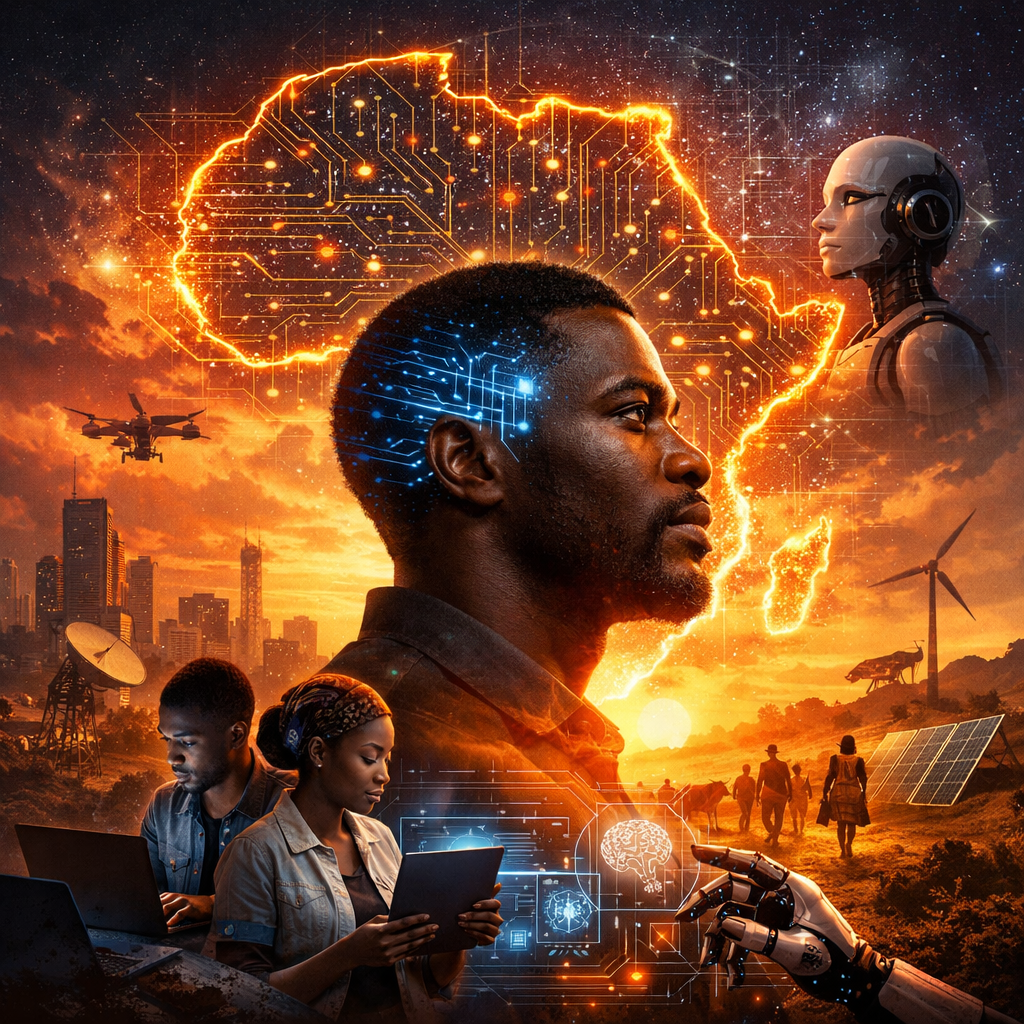
For some time now, I have found myself thinking deeply about Africa’s digital future.Not the kind of thinking that happens during conferences or tech panels where everyone speaks in polished optimism. I mean the kind of quiet reflection that comes after the applause fades, when you sit alone and ask yourself difficult questions about where a continent of more than a billion people is really heading in the age of artificial intelligence.
Everywhere I turn, I hear the same advice repeated like a slogan: Africa must learn to code. It sounds inspiring. It sounds practical. And to be fair, it is not entirely wrong.
But the more I observe the global technology landscape, the more I feel that something crucial is missing from this conversation.
Teaching millions of Africans to code will not automatically secure our digital future. Because in the emerging age of artificial intelligence, the real power does not simply belong to those who write code. It belongs to those who design the intelligence that the world will depend on.
And when I look honestly at the global map of AI today, I cannot ignore a troubling reality.Africa barely appears on it.
Artificial intelligence is not just another technological innovation like smartphones or social media. It is something far more transformative. For the first time in human history, we are building machines capable of learning patterns, making predictions, and influencing decisions on a scale that even governments struggle to control.
That should make all of us pause.
Because the societies that shape these systems will quietly shape the future of knowledge, economics, culture, and power.
At the moment, the race for AI leadership is largely being run by two global giants: the United States and China. Europe is trying to regulate the technology it did not lead in building. Meanwhile, Africa, despite its population, talent, and growing digital energy, remains mostly a consumer of artificial intelligence.
And that reality should concern us.Because in a world increasingly guided by algorithms, the people who build the algorithms also write the invisible rules that others must live by.
Sometimes I imagine what this could mean for the continent.
What happens when African hospitals depend on diagnostic systems trained mostly on foreign medical data?
What happens when educational tools powered by AI do not understand African languages, cultures, or learning environments?
What happens when financial systems use algorithms designed for economies that look nothing like ours?
In such a future, Africa would not just be technologically behind.
It would be digitally dependent.
And dependency, even when it is digital, is still a form of power imbalance.
This is why I believe the conversation about Africa’s digital future must go deeper than slogans about coding.
Coding matters, yes. But the bigger question is this:
Will Africa help shape the intelligence that will define the world, or will it simply adapt to systems created elsewhere?
That question has been quietly bothering me.Across the continent today, we celebrate the growth of startups, fintech innovations, and digital payment platforms. These developments are real achievements and should be acknowledged.
Yet beneath that progress lies a more uncomfortable truth.
Much of Africa’s digital ecosystem runs on infrastructure we do not own.
Our applications operate on global cloud platforms.
Our data often sits in servers outside our borders.
Our artificial intelligence tools rely on models developed by a small group of powerful technology companies such as OpenAI, Google, Microsoft, and Meta Platforms.
When you step back and think about it carefully, a strange picture begins to appear.Africa is becoming increasingly digital but the foundations of that digital world are largely controlled elsewhere.It is a little like building a magnificent house on land that you do not own.
And that thought should challenge us.Yet I am not pessimistic about Africa’s future. In fact, I believe the continent has something that many advanced economies are beginning to lose: demographic vitality and intellectual diversity.
By the middle of this century, Africa will have one of the youngest populations on earth. Within that population lies immense creativity, cultural richness, linguistic diversity, and raw intellectual potential.Artificial intelligence thrives on diversity of data, perspective, and experience.And Africa has those in abundance.
Our challenge is not the absence of talent.
Our challenge is the absence of systems that convert talent into technological power.
When I imagine the kind of digital future Africa truly needs, I do not simply imagine more coding boot camps scattered across cities.
I imagine universities across the continent becoming global centers of AI research focused on African realities from agriculture and climate resilience to disease detection and language preservation.
I imagine African governments beginning to treat data as a strategic national resource, just as important as oil, minerals, or energy.
I imagine a future where African languages like Yoruba, Igbo, Swahili, Amharic, Hausa, and many others are deeply embedded within AI systems so that technology learns to understand the voices and knowledge of the continent.
And above all, I imagine Africa moving gradually from digital consumption to something far more powerful: digital sovereignty.
Because the future will not belong to the societies that merely use artificial intelligence.
It will belong to those who help define it.History has not always been kind to Africa when major technological revolutions arrived. The industrial revolution largely passed the continent by. The early internet era unfolded with limited African participation.
But the age of artificial intelligence presents something different.
It offers a second chance.A chance not just to adopt technology, but to help shape it.
The decisions African leaders, innovators, scholars, and young thinkers make over the next two decades may quietly determine whether the continent becomes a passive participant in the AI era or an active architect of its possibilities.
This is not just a technological matter.
It is a question about the future identity and independence of a continent.
And as I reflect on it all, I find myself returning to a simple but profound question:
Artificial intelligence will undoubtedly shape Africa’s future.
But will Africa have the courage and the vision to shape artificial intelligence in return?