
By Wtr Gideon Tobiloba
In recent years, conversations about artificial intelligence have begun to echo across Africa’s cities, universities, and technology hubs. I hear it in conferences, read it in policy papers, and see it in the excitement of young innovators who believe the continent can become a significant force in the global digital economy.I share that optimism. But I also carry a growing concern.
Each time we talk about Africa’s future in artificial intelligence, we often focus on infrastructure, investment, and digital skills. We ask how many programmers we can train or how many technology startups we can build.
Yet the more I reflect on it, the more convinced I become that Africa’s greatest obstacle in the AI era is something deeper and far less discussed.
It is education.
More specifically, it is the colonial architecture of education that still shapes how millions of African children are taught to think, question, and imagine the future.
And until that structure changes, Africa’s ambitions in artificial intelligence will remain constrained.
The Classroom as the Last Colony
Political colonialism ended across Africa decades ago. Flags changed, governments became independent, and new national identities emerged.
But one of the most enduring legacies of colonial rule quietly remained intact: the education system.
Many African education models were originally designed during the colonial era to serve administrative purposes. Their goal was not to produce inventors or scientists who would challenge global knowledge systems.
Their purpose was far simpler.
They were designed to produce clerks, interpreters, and administrators who could support colonial governance.
The structure reflected that goal.Students memorized facts.They repeated information in examinations.
They were rewarded for obedience rather than curiosity.
Even today, in many classrooms across the continent, learning still revolves around memorization rather than discovery.
The student who repeats the textbook most accurately often receives the highest marks.
The student who asks difficult questions may be seen as troublesome.
But artificial intelligence thrives in environments where questioning, experimentation, and intellectual curiosity are encouraged.
A system built to produce clerks cannot easily produce innovators.
The Stark Numbers Behind Africa’s Education Crisis
To understand the scale of the challenge, one only needs to examine the data.
According to UNESCO, more than 98 million children in sub-Saharan Africa are currently out of school, the largest number in any region of the world.For those who do attend school, the situation is often equally concerning.
Research by the World Bank shows that around 89% of children in sub-Saharan Africa cannot read and understand a simple text by age 10.
This phenomenon has been described as learning poverty.In practical terms, this means that millions of children complete years of schooling without developing foundational literacy and numeracy skills.
Now imagine trying to build a globally competitive artificial intelligence ecosystem on top of such fragile educational foundations.
The gap becomes even clearer at the level of research and innovation.
A study cited by the World Economic Forum suggests that Africa contributes less than 2% of global research output in artificial intelligence and advanced computing fields, despite representing nearly one-fifth of the world’s population.
Meanwhile, countries such as the United States and China dominate the field, investing billions of dollars annually in AI research and development.
The imbalance is not merely technological.It is educational.
Why Artificial Intelligence Requires a Different Kind of Learning
Artificial intelligence is not simply about coding.Behind every intelligent system lies a network of disciplines: mathematics, statistics, computer science, linguistics, psychology, philosophy, and even sociology.AI researchers must be able to question assumptions, test hypotheses, and experiment with new ideas.
Innovation in this field often emerges from environments where intellectual curiosity is encouraged rather than suppressed.
Yet in many African classrooms today, creativity can be treated as distraction, questioning authority can be discouraged, and failure is often punished instead of treated as part of learning.
But every major technological breakthrough in history-from the internet to machine learning, has emerged from cultures that reward experimentation and tolerate failure.If Africa hopes to compete in the AI age, it must cultivate the same intellectual culture.
Africa’s Quiet AI Revolution
Despite the structural challenges, something remarkable is already happening across the continent.
African innovators are beginning to build AI solutions tailored to local realities.
For example, engineers at Data Science Nigeria are training thousands of young Africans in machine learning and data science.
Companies like InstaDeep, founded in Tunisia and now operating globally, are developing advanced AI solutions for logistics, healthcare, and complex decision systems.
Another initiative, Deep Learning Indaba, has created a pan-African network of researchers dedicated to advancing machine learning across the continent.
These examples prove that the talent exists.
What remains missing is an education system capable of producing such innovators at scale.
Africa’s Hidden Advantage in the Age of AIIronically, Africa may possess one of the greatest untapped assets for artificial intelligence.Diversity.
The continent is home to more than 2,000 languages, according to Ethnologue, making it the most linguistically diverse region on earth.
Language is a central challenge in modern AI development.
Most global AI systems today are trained primarily on English and a few major world languages.
This creates limitations when technologies are applied in societies with complex linguistic landscapes.
Africa’s linguistic diversity offers a unique opportunity.
If African researchers build AI models capable of understanding local languages, from Yoruba and Hausa to Swahili and Amharic, they could create systems that operate effectively in multilingual environments across the developing world.
In other words, Africa could help solve one of the most difficult problems in global AI development.
But this opportunity will remain untapped without major educational reform.
Decolonizing Education for an AI Future
Decolonizing education does not mean rejecting global knowledge.Rather, it means redesigning learning systems to serve African realities and ambitions.
It means encouraging critical thinking rather than memorization.
It means funding research universities that can compete globally.
It means building technology curricula that combine computer science with African linguistic, cultural, and social knowledge.
It means empowering students to ask questions that no textbook currently answers.
In essence, it means shifting from an education system designed for administration to one designed for innovation.
The AI Revolution May Begin in the Classroom
When most people imagine artificial intelligence, they picture powerful computers, advanced algorithms, and futuristic laboratories.
But Africa’s most important AI revolution may not begin with machines.
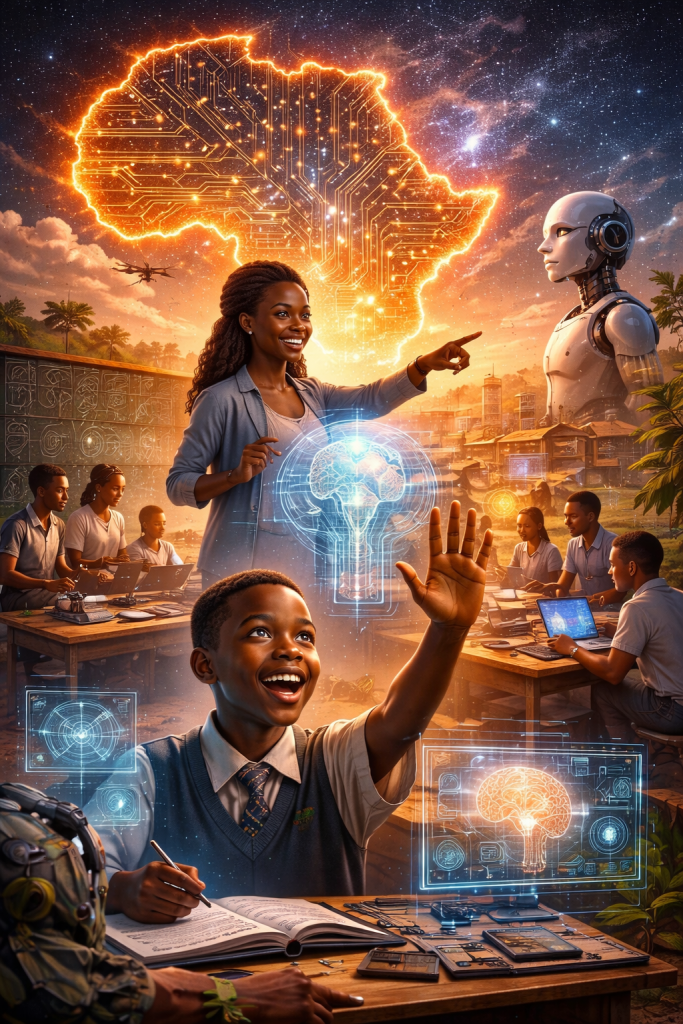
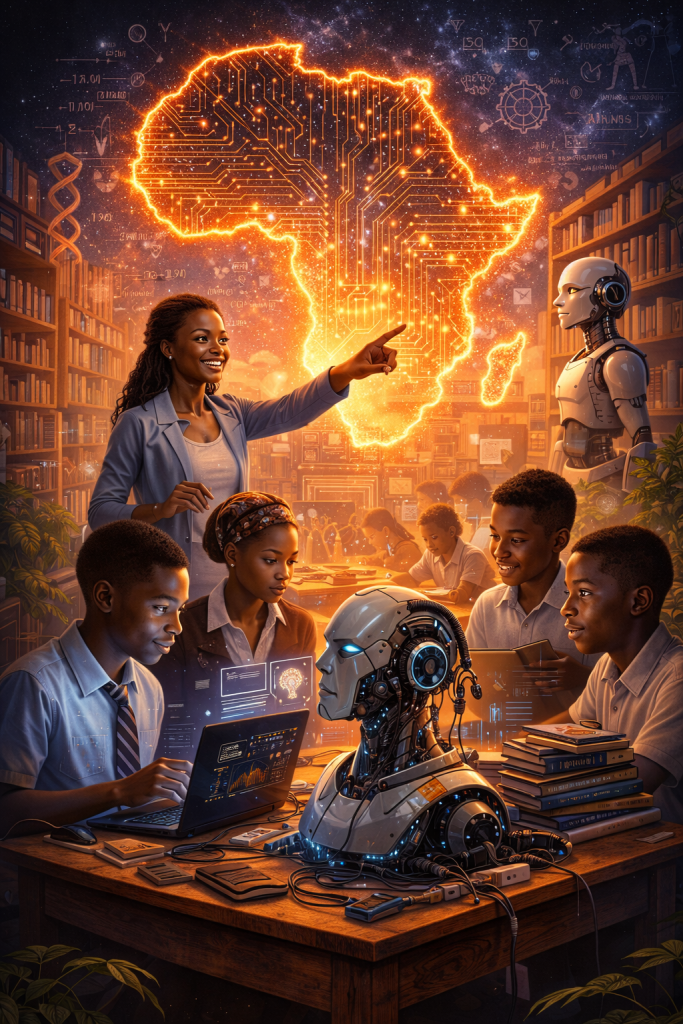
It may begin with a teacher encouraging a student to ask a question.
It may begin with a classroom where curiosity is rewarded instead of discouraged.
It may begin with a generation of young Africans who are not merely trained to repeat knowledge but to create it.
The future of artificial intelligence will undoubtedly influence Africa.
But Africa still has a choice.
It can remain a consumer of digital intelligence built elsewhere.
Or it can reimagine its education systems and begin shaping that intelligence itself.
And as I reflect on the road ahead, I find myself returning to a simple but powerful thought: The most important step toward Africa’s AI future may not be building smarter machines.It may be teaching smarter freedom in the classroom.